You need to build a web application. You have three options: hire an onshore team in your country, work with developers in offshore locations like India or the Philippines, or choose nearshore—developers in nearby time zones with cultural and operational proximity.
Each model has tradeoffs in cost, speed, quality, and risk. Understanding these tradeoffs is how you make the right choice for your business.
The Three Outsourcing Models
Onshore (Same Country)
You hire developers or a development company in your own country. Cost is highest, but so is cultural alignment and timezone overlap.
- Pros: Full timezone overlap, easy face-to-face meetings, same labor laws and regulations, cultural alignment, easiest communication
- Cons: Cost 2-3x higher than offshore, smaller talent pool (developers can choose any company), harder to scale quickly, higher operational overhead
- When to use: When building a core product that needs constant availability, when you need hands-on collaboration with founders, when you have limited time to onboard a team
Offshore (Far Time Zone)
You hire developers in countries with significant time zone differences: India, Philippines, Vietnam, Ukraine. Cost is lowest, but so is timezone overlap and communication ease.
- Pros: Cost 50-70% lower than onshore, large talent pool, 24-hour development cycle possible, can be very fast if well-managed
- Cons: Poor timezone overlap (often 8-12 hours apart), communication requires async workflows, cultural differences can cause misunderstandings, quality variance is higher, onboarding takes longer
- When to use: When cost is the primary constraint, when building non-critical features or internal tools, when you have a strong process for async communication
Nearshore (Nearby Time Zone)
You hire developers in countries with 2-4 hours of timezone overlap: Latin America for US companies, Eastern Europe for Western European companies, India for UK/Australian companies. Cost is moderate—between onshore and offshore.
- Pros: Cost 30-50% lower than onshore, good timezone overlap for real-time communication, cultural proximity (usually English-speaking, similar business practices), quality often matches onshore, easier onboarding
- Cons: Higher cost than pure offshore, smaller talent pool than far-offshore, still some async communication needed
- When to use: When you need quality, speed, and real-time collaboration, when building product features that need feedback loops, when budget is limited but you can't afford onshore
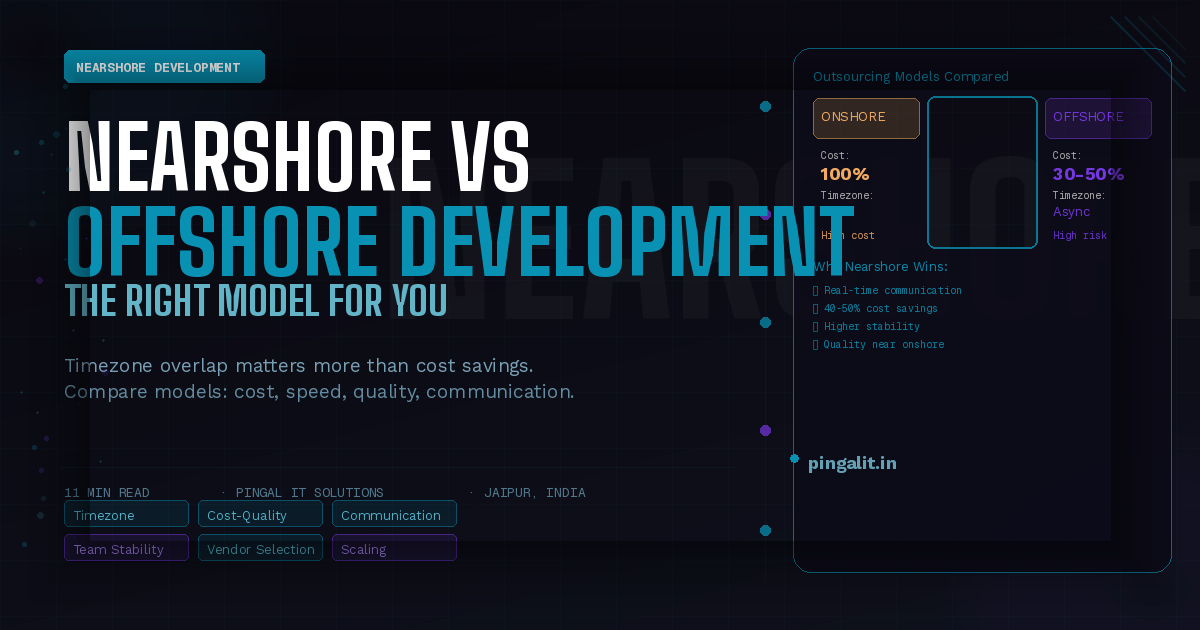
| Model | Cost vs. Onshore | Timezone Overlap | Communication Speed | Quality | Best For |
|---|---|---|---|---|---|
| Onshore | 100% (baseline) | Full (8-10 hours) | Real-time, face-to-face | Highest | Core product, constant availability, startup phase |
| Nearshore | 50-70% | 2-4 hours | Mostly real-time, some async | High | Product features, MVP, growth stage |
| Offshore | 30-50% | 0-2 hours (often opposite shift) | Mostly async, handoff-based | Variable | Non-critical work, cost-sensitive projects, internal tools |
Why Nearshore Is the Smart Middle Ground
Nearshore development solves the core problem with pure offshore: the communication gap. When your development team is 12 hours ahead or behind, every question requires waiting until the next day. A bug found in QA needs 24 hours to get a response. A design clarification means two days of iteration instead of two hours.
With nearshore, you get same-day turnaround. Your 9 AM meeting can include the dev team. A question at 4 PM gets answered before end of business. This matters far more than you think. A 2-hour timezone overlap compounds into weeks of saved time over a project.
Nearshore also offers quality advantage. Developers in nearshore locations often have higher English fluency, better understanding of Western business practices, and more stability in their role (they're not using your company as a stepping stone while hunting for onshore visas).
And the cost difference is real. Nearshore is 30-50% cheaper than onshore—the difference between a $50K/month team and a $30K/month team. Over 12 months, that's $240K in savings. Offshore might be $20K/month, but those savings disappear when you factor in rework, delays, and the time you spend managing async communication.
The Hidden Costs of Offshore Savings
Pure offshore is seductive on the spreadsheet. A developer in India costs $15-20/hour. The same person onshore costs $60-100/hour. But this comparison is misleading because it doesn't account for the real cost of distance.
Communication Overhead
When your dev team is 12 hours ahead, every question becomes async. You write an email. 12 hours later, you get a response. You clarify. Another 12 hours. A decision that should take 1 hour takes 2 days. Over a month, this adds 20-30% overhead to your timeline.
Quality Rework
Offshore teams often have less context about your business. A feature built offshore without real-time feedback is more likely to miss the mark. Rework—rebuilding something because it wasn't quite right—adds 10-30% to the cost.
Onboarding and Turnover
A good offshore developer might leave after 18 months for better onshore opportunities. Onboarding a new developer takes 4-6 weeks. You've lost 6+ months of productivity just from turnover. Nearshore developers are more stable because they've already optimized for timezone and can earn excellent income without relocating.
Management Burden
Offshore teams require more structured project management, more detailed documentation, more async communication tools. This adds overhead to your side. Nearshore allows looser, more natural management because real-time communication is possible.
The math: Offshore developer at $18/hour looks like 50% savings. But add 20% communication overhead, 20% rework, 15% management burden, and 25% for turnover costs? You've lost most of your savings.
When Offshore Still Makes Sense
Pure offshore is the right choice in specific scenarios:
- Non-critical features: Building internal admin dashboards, test frameworks, or lower-priority features where delays don't impact customers
- Data processing and batch work: Building ETL pipelines, data cleaning, or batch reporting where async communication fits naturally
- Cost is the constraint: You have less than $50K budget for a project and quality can be lower
- You have a strong async process: Your team excels at detailed documentation and async communication—this is rare
But for building product features, working on critical systems, or developing with your customers, nearshore beats offshore almost every time.
How to Evaluate a Nearshore Development Partner
Not all nearshore providers are equal. When evaluating, look for:
- Timezone overlap: Confirm actual working hours. "Nearshore" means nothing if your team starts at 4 PM your time
- English fluency: Your tech lead should speak English natively. Miscommunication in product specs is expensive
- Stability: How long have developers been with the company? High turnover is a red flag
- Relevant experience: Have they built products like yours? Portfolio matters
- Communication channels: Can they do real-time calls, Slack, pair programming? Or only email?
- Pricing model: Are you paying per hour, per sprint, or fixed-price? Hour rates are lowest cost but often lead to scope creep
When evaluating development partners for your project, Pingal IT's custom software services use a hybrid model: full timezone overlap with the US, UK, and Australia, native English speakers, fixed-sprint pricing, and dedicated team assignments to minimize turnover. This is the nearshore model done right—not the lowest cost, but the best value for product-critical work.
The Nearshore Advantage for Global Startups
If you're building a software product and you're not onshore, nearshore is your sweet spot. You get quality close to onshore, cost 40-50% lower, and timezone overlap that makes real-time collaboration possible.
Onshore costs too much when you're bootstrapped or early-stage. Offshore costs too little in hidden ways—delays, rework, management burden. Nearshore is the Goldilocks option: not too expensive, not too risky, timezone overlap that compounds into speed.
For web development, mobile app development, and custom software, nearshore providers from India, Eastern Europe, and Latin America are your best option if you're building product with founders who need real-time feedback. The timezone overlap with US, UK, EU, and Australia markets means you get same-day communication, quality that matches onshore teams, and cost savings that actually materialize.
Nearshore Development Checklist
- ✅ Defined your project scope and timeline (so you can evaluate timezone overlap value)
- ✅ Set your budget and confirmed nearshore is affordable vs. onshore
- ✅ Identified which timezone region fits best (Latin America for US, Eastern Europe for EU, India for UK/AU)
- ✅ Evaluated 3-5 nearshore providers with case studies in your domain
- ✅ Confirmed English fluency and communication channels (real-time calls, Slack, pair programming available)
- ✅ Checked team stability (developer retention rates at the company)
- ✅ Negotiated fixed-sprint pricing, not hourly billing (prevents scope creep)
- ✅ Planned onboarding: dedicated PM, kickoff call, detailed requirements document
FAQs
Is nearshore development risky?
No more than any outsourcing. Risk comes from poor vendor selection and unclear requirements, not timezone. The best nearshore providers are as reliable as onshore teams. Check references and past projects carefully.
Will my nearshore team steal my code or ideas?
No. IP theft is extremely rare because developers benefit from reputation, not from stealing ideas. If you're concerned, use NDAs and IP assignment clauses in your contract—this is standard practice.
How do I manage a nearshore team?
With real-time communication, management is much like onshore. Daily standup calls, Slack for async updates, pair programming for complex problems. The timezone overlap makes normal management practices work.
What if the nearshore team quits midproject?
This is rare with reputable nearshore companies. They have institutional knowledge and client satisfaction tracking. Evaluate turnover rates when choosing a partner. Avoid one-person shops.
Can I scale a nearshore team quickly?
Yes. Unlike hiring onshore (3-6 month hiring cycle), nearshore companies can often add resources within 2-4 weeks. This is an advantage for growing projects.
How is quality different between nearshore and onshore?
When evaluating development partners, quality depends on the individual company, not the location. A good nearshore team produces code equal to a good onshore team. Bad vendors exist in both categories. Judge on portfolio and references.
What's the pricing difference between nearshore and onshore?
Nearshore is typically 40-50% less than onshore for similar quality. A $100K onshore project might be $50-60K nearshore. The savings are real and material.
Should I hire nearshore developers or a nearshore agency?
Freelance developers are cheaper but higher risk (they disappear, lack backup when sick, no institutional process). Agencies cost more but offer stability, process, and accountability. For product work, an agency is usually worth the cost.