What Is Technical Debt and Why It Matters
Your engineering team is slower than it was six months ago. Features that used to ship in a week now take three. Nobody's process changed. The codebase just became harder to work with.
This is technical debt. It's the accumulated cost of shortcuts, outdated patterns, missing tests, and architectural compromises made to ship faster earlier. Each shortcut seemed reasonable at the time. But they compound. A quick hack done in 2024 forces a rewrite in 2026. A missing test suite means every change risks bugs. An API redesign deferred twice now blocks four teams.
Technical debt is real debt: it has real interest. The interest is paid in slower development velocity, higher defect rates, and team frustration. Unlike financial debt, which you can ignore briefly, technical debt cannot be ignored — it only gets more expensive.
The question is not whether you have technical debt. Every growing system does. The question is whether you're paying it down faster than you're accumulating it.
Why Technical Debt Accumulates
Technical debt is not a failure of discipline. It's a natural consequence of shipping software under time pressure.
Pressure to Deliver
When your business is growing and customers need features now, engineers make rational tradeoffs. They choose a solution that works today over a perfect solution that takes twice as long. This is not negligence — it's business triage.
Changing Requirements
Code written to solve problem A becomes awkward when problem B arrives and you're shipping feature C. Refactoring to handle all three takes time you don't have. So you layer the new feature on top. The codebase becomes a palimpsest of past decisions, each one reasonable at the time.
Hiring and Onboarding
As teams grow, new engineers inherit code they didn't write. They understand it less deeply. Fixing something risky feels more dangerous when you're unsure. So they add more tests and more documentation than a founder-engineer would. This is healthy, but it's also a cost.
Technology Changes
The best practice in 2022 is a known anti-pattern in 2025. Your monolith that made sense at 10 people becomes a bottleneck at 50. The database choice that was optimal for your first product is suboptimal for your second. Keeping up with technology is a form of technical debt — the cost of staying current.
Measuring Technical Debt — You Can't Manage What You Don't Measure
The first step is visibility. Technical debt is invisible until you try to measure it.
Developer Velocity
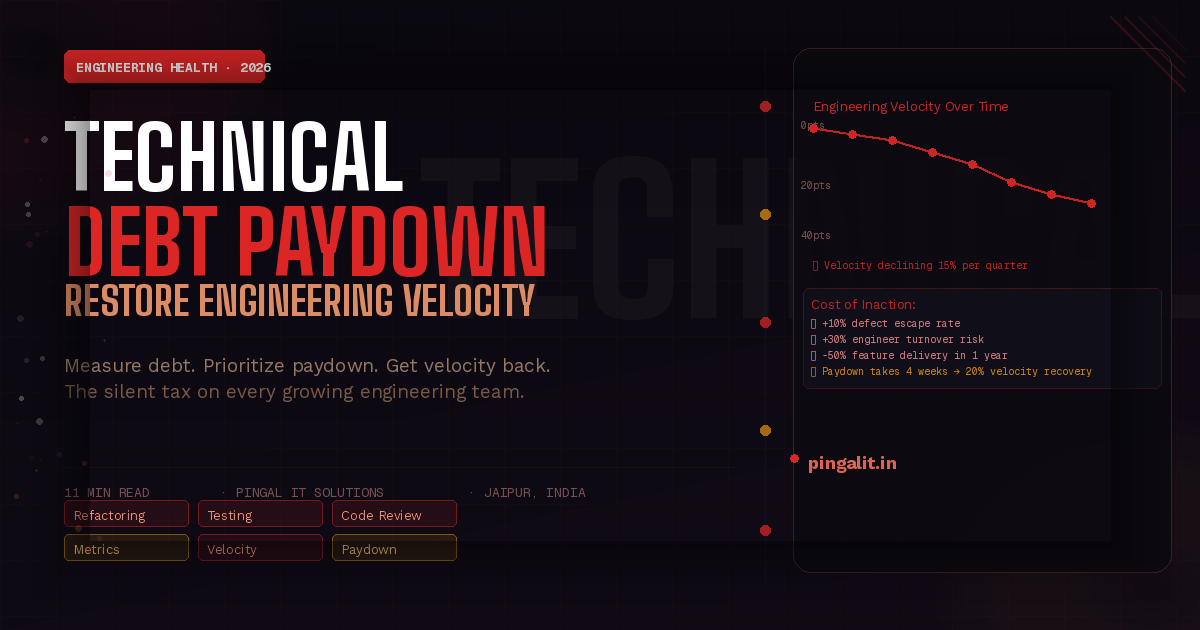
Track how long typical features take to ship. If velocity is declining quarter over quarter (absent major architecture changes or growing team burden), technical debt is likely the cause. A 20% velocity decline over 6 months, with no corresponding complexity increase, signals significant debt.
Code Churn and Rework
How often are the same files being modified? If you're touching the same 10 files repeatedly to add features, that's a code smell. Those files are probably doing too much and are brittle.
Defect Escape Rate
Bugs found by customers versus bugs found before release. As technical debt accumulates, test coverage usually decreases (it's harder to test brittle code). The escape rate rises. When defects in production start increasing despite efforts to prevent them, debt is compounding.
Time Allocation
Ask your team: how much time this sprint went to features versus bug fixes, refactoring, and paying down debt? Healthy teams allocate 70-80% to features, 20-30% to technical work. If you're below 60% feature time, debt is consuming resources.
Static Analysis and Linting
Tools like SonarQube, Code Climate, or language-specific linters can measure code quality objectively: cyclomatic complexity, test coverage, duplicate code, known anti-patterns. These metrics don't tell the full story, but they're a starting point.
| Metric | What It Signals | Healthy Range | Action Zone |
|---|---|---|---|
| Developer Velocity | Features delivered per sprint | Stable or slowly growing | Declining 3+ quarters in a row |
| Test Coverage | % of code exercised by tests | 70-85% | Below 50% or impossible to increase |
| Defect Escape Rate | % of bugs found by users | 5-10% | Above 20% or rising |
| Code Review Cycle Time | Time to merge a PR | 1-2 days | Above 1 week (indicates complexity or process drag) |
| On-Call Incidents | Production failures per month | Stable, < 2 per month | Rising trend or > 5 per month |
When to Pay Down Technical Debt
The question is not whether to address technical debt. The question is when and how much. Three scenarios demand attention.
Scenario 1: Velocity Is Collapsing
Velocity decline is the most visible symptom. If your team shipped 40 story points per sprint and now ships 20, with no increase in story size or scope, the codebase is the bottleneck.
Action: Dedicate one sprint per quarter (minimum) to technical debt paydown. Measure whether velocity recovers. If it doesn't, the debt is deeper than you thought — dedicate more.
Scenario 2: Defect Escape Rate Is Rising
When customers find bugs that should have been caught before production, two things are happening: test coverage is inadequate, and the code is too complex for humans to reason about safely.
Action: Block features for a sprint. Invest in test infrastructure and refactoring to improve clarity. Cover the riskiest code paths first.
Scenario 3: Engineers Are Threatening to Leave
The silent cost of technical debt is engineer satisfaction. Spending weeks fighting with brittle code is demoralizing. Many senior engineers will leave rather than continue working in a debt-ridden codebase.
Action: Make paydown visible. Show the team that management recognizes the debt and is committing time and resources to fix it. Dedicate 1-2 engineers to debt paydown full-time. Make progress visible.
Strategies for Paying Down Technical Debt
1. Refactor High-Churn Code First
Not all debt is equally costly. Code that changes frequently is more expensive to keep broken than code that's stable. Prioritize refactoring the files you touched most in the past quarter.
2. Improve Test Coverage Before Refactoring
Don't refactor untested code. Refactoring untested code is how you introduce bugs. Write tests first. Once a component is well-tested, refactoring is safe and fast.
3. Extract Libraries, Services, or Modules
When one piece of code is doing too many things, breaking it into smaller, focused units reduces cognitive load and complexity. Extract a utilities library. Break a monolithic service into smaller ones. Carve out a domain model.
4. Document the Reasoning, Not Just the Code
Code comments should explain the why, not the what. Why did we use this algorithm? Why this architectural choice? Why this unusual pattern? This helps future engineers understand constraints and avoid repeating mistakes.
5. Establish Paydown Cadence, Not Random Bursts
Teams that dedicate 20% of every sprint to debt paydown progress steadily. Teams that leave it until crises force a "debt sprint" fail—the debt is too large to tackle in one sprint, and when the crisis passes, debt paydown stops.
Establish a rhythm: every sprint, dedicate the equivalent of one engineer's full capacity, or 20% of team capacity, to debt paydown and refactoring.
6. Make Paydown a Performance Metric
Engineers should be evaluated not just on features shipped, but on codebase health and technical work. If paydown is not valued, it won't happen when features are on the roadmap.
The Cost-Benefit Tradeoff
Paying down technical debt has real costs: slower feature delivery in the short term, people allocated to non-customer-facing work, and engineering time.
But not paying down debt also has costs—and they accelerate exponentially. Research on software engineering teams shows that systems with high technical debt experience 40-50% slower development cycles, 3-4x higher defect rates, and significantly higher engineer turnover.
The math is simple: if debt paydown takes 4 weeks but restores 20% of velocity, that 4 weeks pays for itself within 2 months. After that, it's pure gain.
| Strategy | Paydown Timeline | Team Disruption | Velocity Impact |
|---|---|---|---|
| Continuous refactoring (20% allocation) | 6-18 months (depending on debt depth) | Low (integrated into normal work) | Short-term: -10% to 0%. Long-term: +30-50% as debt decreases |
| Quarterly debt sprint (full team, 1 sprint) | 1-3 years (slow but achievable) | Medium (features pause for 2 weeks) | Short-term: -100% (no features that sprint). Long-term: +15-25% per sprint refactored |
| Full rewrite | 6-12 months (very risky) | Very high (parallel teams, coordination nightmare) | Short-term: -60% (people on rewrite). Long-term: highly variable (often disappointing) |
| Do nothing | N/A | N/A | Continues declining 10-15% per quarter until team stalls |
How Pingal IT Solutions Addresses Technical Debt
When Pingal IT Solutions takes over or rebuilds a system, technical debt assessment is always part of the engagement. We review the codebase for:
- Test coverage and testability issues
- Architectural patterns that have become anti-patterns
- Code that's doing multiple jobs (mixed concerns)
- Documentation gaps and unclear reasoning
- Dependencies on outdated libraries or patterns
We then build a debt paydown roadmap that balances feature delivery with codebase health. This often means establishing a continuous refactoring discipline—allocating a percentage of each sprint to tech work—rather than trying to tackle all debt at once.
For teams considering whether to refactor internally or outsource, the question is: does your team have the bandwidth and expertise? If your best engineers are drowning in the current codebase, bringing in specialists to tackle the debt frees them to focus on customer features. Pingal IT's custom software services include legacy code assessment and refactoring, helping teams bridge the gap between their current technical state and where they need to be.
Technical Debt Checklist
- ✅ Measured velocity over the past 6 months. Is it declining?
- ✅ Measured test coverage. Is it below 60%?
- ✅ Measured defect escape rate. Is it above 15%?
- ✅ Asked the team: how much time goes to debt paydown? Is it less than 20%?
- ✅ Identified the highest-churn files. Are they also the most complex?
- ✅ Established a refactoring cadence. Is 20% of sprint capacity allocated to tech work?
- ✅ Made codebase health a team goal. Is it in performance reviews?
- ✅ Communicated paydown progress to stakeholders. Are they aware of the investment?
FAQs
Should we do a full rewrite to escape technical debt?
Rarely. Full rewrites are extremely expensive, high-risk, and almost always take longer than expected. You lose all the bug fixes and edge-case handling embedded in the old code. Continuous refactoring is cheaper and safer. A rewrite is justified only when the architecture is fundamentally wrong for your current business (e.g., monolith to microservices for a company at 100+ engineers).
How do we know when debt is "acceptable"?
Acceptable debt doesn't block customer features or cause engineer attrition. It's debt where you've made conscious tradeoffs and are paying it down systematically. If debt is slowing your team, it's not acceptable.
Can we ignore technical debt if we're growing fast?
No. Ignoring debt during growth is how you hit a wall at 50 engineers where the team can barely ship anything. Paydown during growth is more important than paydown during stability because the cost of ignoring it compounds with team size.
Who should lead technical debt paydown?
A senior engineer or architect. They understand the current codebase and the vision for where it should go. Give them authority to make paydown decisions and protect them from constant feature requests during refactoring sprints. They need uninterrupted time to move the needle.
How do we prevent accumulating new debt while paying down old?
Code review and standards. If your code review process asks "is this maintainable?" and "do we have tests?" then you slow down new debt accumulation. Establish a definition of done that includes test coverage and clear naming. Make technical standards visible and enforced.
What if our technical debt is from 5 years of decisions we can't change?
You're in a position many growing companies find themselves in. The path forward is incremental, not revolutionary. Refactor the highest-churn parts. Cover the riskiest logic with tests. Extract libraries and modules to reduce coupling. You won't fix everything, but you can make things better enough to restore velocity.
Should engineers be writing documentation for old code before refactoring?
Yes, but briefly. Before refactoring, write a comment explaining the current design and why it exists. This protects you from breaking assumptions baked into the code. Then refactor to make it clearer. Bad code with good documentation is better than bad code without it, but clear code is best.
Is technical debt ever strategic?
Yes. Taking on debt deliberately to hit a market window or ship a critical feature can be the right call. The key word is "deliberately"—you know you're taking on debt and you have a plan to repay it. Unknowingly drifting into debt is a failure of engineering culture.