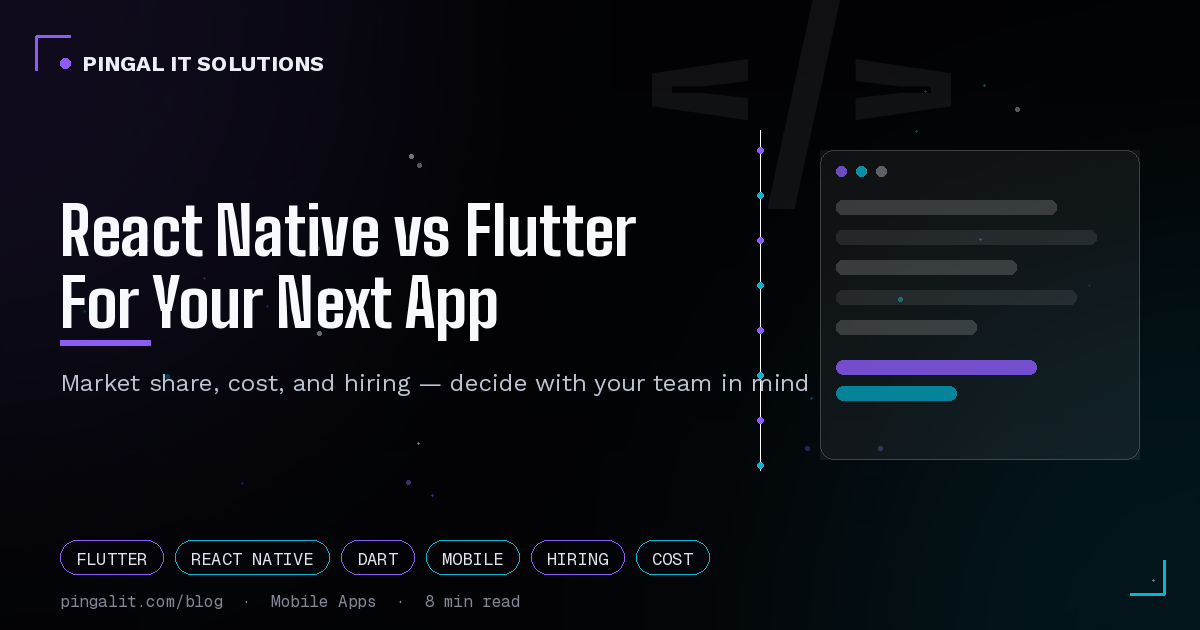
Flutter and React Native are both production-ready choices for a cross-platform business app in 2026, and the right pick depends far more on your team and timeline than on either framework's raw performance. Flutter currently holds a larger share of new cross-platform builds and tends to edge out React Native on animation-heavy, pixel-perfect interfaces. React Native gives you a much larger hiring pool and lets a team that already knows JavaScript ship faster, because there's no new language to learn.
Neither answer is universally correct. Below is the decision broken into the factors that actually change the outcome for a business commissioning an app, not a developer choosing a hobby project.
What Are Flutter and React Native, in Plain Terms?
Flutter is Google's open-source UI toolkit. It draws every pixel itself using its own rendering engine rather than relying on each platform's native components, which is why it looks and behaves identically on iOS and Android. It uses Dart, a language most business teams don't already know.
React Native is Meta's framework for building mobile apps with JavaScript and React, rendering to real native UI components under the hood. Any team that has built a React web app already has most of the mental model needed to pick it up — a familiarity edge borne out in the Stack Overflow 2025 Developer Survey, where JavaScript remains the most widely known language among professional developers.
The Numbers That Actually Matter for a Business Decision
| Factor | Flutter | React Native |
|---|---|---|
| Cross-platform market share (2026) | ~46% | ~35% |
| Language | Dart (new for most business teams) | JavaScript/TypeScript (familiar to most web teams) |
| Hiring pool size | Smaller, growing | 4–5x larger globally |
| Typical offshore rate | $45–$65/hr mid-level | $40–$60/hr mid-level |
| Rendering approach | Self-drawn (Impeller engine) — pixel-identical across platforms | Native components via the New Architecture (Fabric/TurboModules) |
| Best fit | Brand-heavy, animation-rich, multi-platform apps (including desktop/web from one codebase) | Teams with existing React/JS skills; apps sharing logic with a web product |
This decision usually comes up alongside a broader custom software development scoping conversation, since the mobile app is rarely the only system involved. Both frameworks retired their older, criticized architectures in the past two years. React Native's bridge-based communication between JavaScript and native code — long the source of animation jank complaints — has been replaced by the New Architecture, which is now the default. Flutter's Impeller rendering engine replaced Skia as the default on both platforms. The old performance gap that made this an easy call in 2022 has mostly closed.
When Flutter Is the Right Call
- Your app needs to look and animate identically across iOS, Android, and potentially web or desktop from one codebase
- Brand consistency matters more than platform-native feel — the app should look like your product, not like an iOS app and a separate Android app
- You're building something animation- or graphics-heavy, where Flutter's rendering control gives a real, visible edge
- You're comfortable with a smaller (though fast-growing) talent pool and don't need to hire quickly at scale
When React Native Is the Right Call
- Your team already knows JavaScript or React, and ramp time matters — a JS-fluent developer typically becomes productive in React Native in 2–3 weeks versus 4–6 weeks learning Dart from scratch
- You want to share business logic or components between a web app and mobile app
- You need to hire or scale a team quickly — the pool is several times larger, which shortens time-to-hire and gives more negotiating room on rate
- You need deep, frequent native module access for something like custom Bluetooth hardware or a proprietary SDK
What This Actually Costs
Framework choice moves the budget less than people expect. Both frameworks land in a similar band for a comparable-scope app — see our detailed breakdown of custom application development cost for how tiers and timelines translate to a budget. The bigger cost driver is almost always integration complexity (payments, native SDKs, offline sync) and design depth, not which of these two frameworks you pick. Where framework does move cost meaningfully: if you need a genuinely native-feeling, platform-specific UI (different navigation patterns on iOS vs Android, for instance), that's easier and cheaper in React Native, because it starts from native components rather than drawing its own.
What a Proof of Concept Looks Like in Each Framework
If you're still undecided, a short proof-of-concept build is worth more than another comparison article — including this one. Here's what that typically looks like in practice, scoped to a single core screen with real data:
| Proof-of-concept scope | Flutter | React Native |
|---|---|---|
| Typical timeline | 1–2 weeks | 1–2 weeks (faster if the team already knows React) |
| What you learn | Whether Dart's learning curve is acceptable for your team; how the UI feels on both platforms | Whether existing React/web code can realistically be shared or reused |
| Typical cost | $3,000–$8,000 | $3,000–$8,000 |
Treat this as a hiring and workflow test as much as a technical one. The framework rarely fails outright at this stage — what you're really testing is whether your team enjoys working in it enough to commit to it for the next three years of maintenance.
Migrating an Existing App: What It Actually Involves
If you already have a React Native or Flutter app and are reconsidering, understand this up front: there is no supported migration path between the two. You are not porting code, you're rebuilding the UI layer from scratch, though business logic, API contracts, and backend services carry over largely untouched. For a mid-complexity app, that's typically 50–70% of the cost of the original build, concentrated in UI and platform-integration work rather than backend logic. This is why the framework decision is worth getting right upfront rather than treating it as easily reversible later — it's closer to choosing a building material than picking a paint color.
How Pingal IT Chooses Between Them
We default to React Native for client projects unless there's a specific reason not to — mainly because the hiring pool and JS-ecosystem familiarity mean fewer surprises over a multi-year maintenance life, and most of our clients' teams already think in JavaScript. We move to Flutter when the brief is explicitly design-led and cross-platform pixel consistency is a stated requirement, or when a client wants one codebase covering mobile, web, and desktop from day one. We don't think "Flutter is objectively better performance" is a good enough reason on its own anymore — the New Architecture closed that gap for most business apps, and we'd rather optimize for who you can hire to maintain the app in three years.
Ecosystem Maturity: Where Each Framework Still Has Gaps
Market share numbers hide a real practical difference: the size and depth of each framework's library ecosystem for solving specific problems. React Native's package ecosystem is built on top of npm, giving it access to a vastly larger pool of maintained packages — useful when you need something specific like a particular payment SDK wrapper or a niche analytics integration that someone has likely already built. Flutter's ecosystem on pub.dev is smaller but has matured quickly, and for the common cases (maps, push notifications, in-app purchases, camera access) both frameworks now have solid, well-maintained options. Where the gap still shows up is in the long tail: obscure hardware SDKs, older enterprise APIs, or platform-specific features a client's existing vendor exposes only through a native iOS or Android library. If your app depends on one of those, check for an actively maintained package in your chosen framework before committing — not just a plugin that technically exists but hasn't been updated in two years.
Checklist: Decide in 15 Minutes
- Does your team already know JavaScript/React? If yes, that's a real head start for React Native.
- Do you need pixel-identical UI across platforms, or is platform-native behavior actually preferable?
- Will this app ever need to become a web or desktop app from the same codebase? Flutter has the edge here.
- How fast might you need to scale the team? React Native's larger pool matters more the faster you need to hire.
- Does the app need deep native hardware or SDK integration? Weigh this against each framework's current library support before committing.
For a broader look at when a mobile app is worth building at all, see our piece on whether your app idea is worth building, and browse our mobile app development work for examples of both frameworks in production.
FAQs
Is Flutter or React Native better for performance?
They're close enough for the overwhelming majority of business apps that performance shouldn't be the deciding factor. Flutter has an edge in animation-heavy, complex-UI scenarios; React Native's New Architecture has closed most of the older gap for typical CRUD and content apps.
Which is cheaper to build, Flutter or React Native?
Roughly the same for comparable scope. Offshore mid-level rates run $40–$65/hour for either framework. Integration complexity and design depth affect the budget far more than the framework choice itself.
Can I switch frameworks later if I choose wrong?
Technically yes, but it means a substantial rebuild, not a migration — the two frameworks don't share code. Treat the choice as a 3+ year commitment and weigh hiring and maintenance, not just initial build speed.
Do I need separate native iOS and Android developers instead?
Only for apps with extreme performance requirements (games, AR/VR, heavy device integration) or platform-specific features that cross-platform frameworks can't reach. For most business apps — internal tools, customer-facing apps, marketplaces — cross-platform is the right default and meaningfully cheaper.
Is Dart hard to learn if my team only knows JavaScript?
It's a manageable 4–6 week ramp for an experienced developer, not a major barrier, but it is real ramp time you should budget into your first Flutter project's timeline if your team is starting from zero.
Which framework has better long-term support?
Both are backed by major companies (Google and Meta respectively) with active, well-funded development and no signs of deprecation. Neither is a safe-vs-risky choice at this point — the risk is in your team's fit, not the framework's longevity.