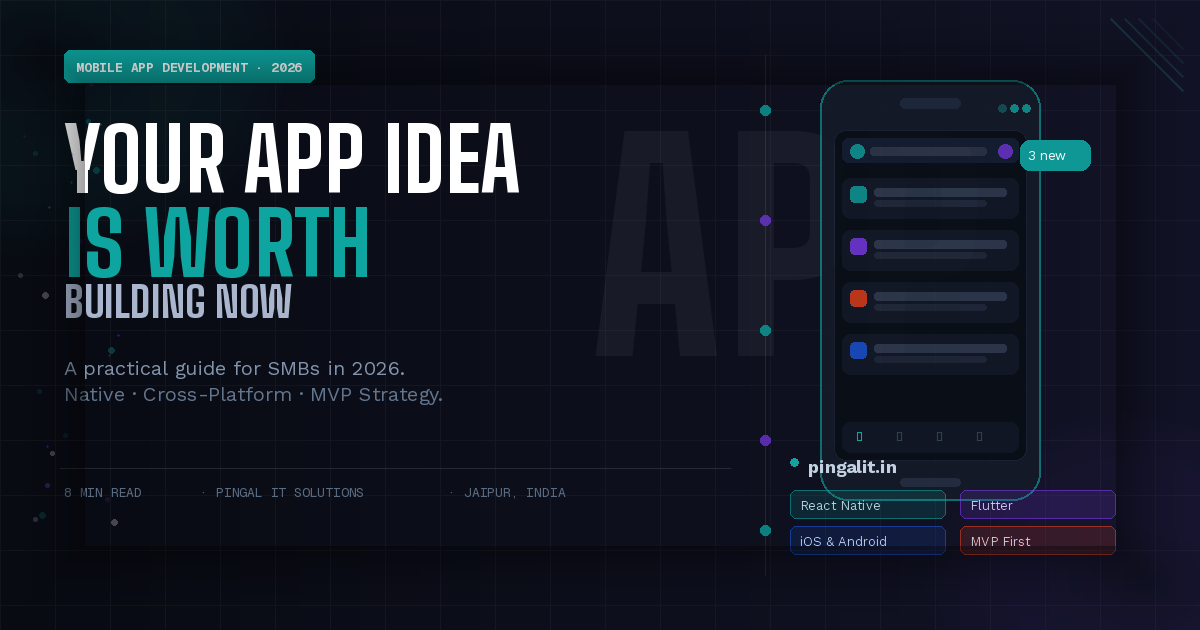
There's a moment every business owner reaches — someone on the team says, "We should have an app for this." And then nothing happens. The idea gets shelved because it feels too expensive, too complex, or too uncertain.
In 2026, that hesitation is costing businesses more than they realise. Mobile app usage has overtaken desktop across nearly every industry, and SMBs that own their mobile experience are growing faster than those still relying on websites and third-party platforms alone.
This guide breaks down exactly what you need to know before building your first mobile app — and how to make it a business asset from day one.
Why Mobile Apps Matter More Than Ever for SMBs
It's no longer just about having a presence on someone's phone. A well-built mobile app gives your business a direct, always-on channel to your customers — no algorithm, no middleman, no rental fee to a platform you don't own.
Consider what a mobile app actually unlocks for a small or mid-sized business:
- Push notifications — reach your customers directly, anytime, with offers, updates, or reminders
- Offline functionality — your service works even without an internet connection
- Device features — camera, GPS, biometrics, contacts — all available to enhance your product
- Customer loyalty — users who install your app engage 3–4x more than mobile web visitors
- Data ownership — you collect first-party data, not a platform's curated slice of it
The question is no longer should you build an app. It's what kind — and when.
Native vs. Cross-Platform — Which Is Right for You?
This is the first real decision every business faces, and the wrong choice can cost time and money down the line. Here's a plain-English breakdown:
| Factor | Native App (iOS & Android separately) | Cross-Platform App (React Native / Flutter) |
|---|---|---|
| Performance | ✅ Highest — built for the OS | ✅ Near-native for most use cases |
| Development Cost | ❌ Higher — two codebases | ✅ Lower — one shared codebase |
| Time to Market | ❌ Slower | ✅ Faster |
| Best For | Complex apps, gaming, hardware-heavy | Business apps, portals, e-commerce |
| Maintenance | Two separate update cycles | ✅ Single codebase to maintain |
For most SMBs, a cross-platform approach using React Native or Flutter delivers the best balance of speed, cost, and quality. You get one app that works beautifully on both iOS and Android — at roughly 60–70% of the cost of going fully native.
5 Types of Mobile Apps That Deliver Strong ROI for SMBs
Not every app idea is equal. These are the categories where SMBs consistently see the strongest return on their development investment:
1. Customer-Facing Service Apps
Let customers book appointments, place orders, track deliveries, or access their account — all from their phone. Businesses in hospitality, healthcare, retail, and logistics see the fastest ROI here.
2. Internal Operations Apps
Replace paper forms, WhatsApp groups, and spreadsheets with a purpose-built internal tool. Field teams, delivery drivers, warehouse staff, and sales reps all benefit enormously from a dedicated mobile workflow.
3. E-Commerce & Marketplace Apps
If you sell products — physical or digital — a dedicated app consistently outperforms a mobile website on conversion rates, cart abandonment, and repeat purchase behaviour.
4. Loyalty & Engagement Apps
Restaurants, salons, gyms, and retail stores use loyalty apps to build habitual engagement. Push notifications alone can drive a measurable uplift in monthly active visits.
5. On-Demand Service Apps
Home services, cleaning, tutoring, freelance work — the on-demand model works at any scale. A well-designed app lets you match supply with demand in real time.
The 6 Biggest Mistakes SMBs Make When Building Their First App
Most failed apps don't fail because the idea was bad. They fail because of avoidable mistakes made before a single line of code is written. Here are the six to watch out for:
Mistake 1 — Trying to Build Everything at Once
The number one killer of mobile app projects is scope creep. Start with a Minimum Viable Product (MVP) — the smallest version of your app that delivers real value to real users. Launch, learn, and iterate. You'll save money and ship faster.
Mistake 2 — Skipping the UX Design Phase
Users are ruthless. If your app is confusing or slow within the first 30 seconds, they delete it — and rarely come back. Investing in UX design before development begins is the highest-leverage spend in your entire project budget.
Mistake 3 — Ignoring App Store Optimisation (ASO)
Building a great app and not optimising its App Store listing is like building a great shop and hiding the signage. Your app name, screenshots, description, and keywords determine whether organic users ever find you.
Mistake 4 — Not Planning for Updates & Maintenance
An app is not a one-time expense. iOS and Android release major OS updates annually — your app needs to stay compatible. Budget for ongoing maintenance from day one.
Mistake 5 — Choosing the Cheapest Developer
A poorly built app damages your brand. Users associate a buggy, slow experience with your business — not your developer. The cost of rebuilding a bad app is always higher than building it right the first time.
Mistake 6 — No Analytics from Day One
If you can't see how users move through your app, you can't improve it. Integrate analytics before launch — not as an afterthought six months later.
What Does It Cost to Build a Mobile App in India in 2026?
Costs vary significantly based on complexity, platform, and the development partner you choose. Here's a realistic ballpark:
| App Type | Estimated Cost (INR) | Timeline |
|---|---|---|
| Simple MVP (1 platform) | ₹1.5L – ₹3.5L | 4–8 weeks |
| Mid-complexity cross-platform app | ₹4L – ₹10L | 2–4 months |
| Full-featured business app | ₹10L – ₹25L+ | 4–8 months |
| Enterprise / On-Demand platform | ₹25L+ | 6–12 months |
💡 Pingal IT Tip: Always ask for a fixed-scope quote for your MVP phase. This gives you a working product in users' hands quickly — without committing your entire budget upfront. Subsequent phases are scoped based on what real users actually need.
How Pingal IT Solutions Approaches Mobile App Development
At Pingal IT Solutions, Jaipur, we've built mobile applications across industries — from retail and logistics to healthcare and fintech. Our approach is built around one principle: your app should work for your business, not just look good in a demo.
Discovery First
We map your user journeys, define your MVP scope, and identify the features that will drive engagement before a single wireframe is drawn.
Design-Led Development
Our UI/UX team creates interactive prototypes you can test with real users. You sign off on the experience before development begins — no expensive mid-project pivots.
React Native & Flutter Expertise
We build cross-platform apps that feel native on both iOS and Android, using modern frameworks that are fast to build, easy to maintain, and backed by large developer communities.
API Integration & Backend Development
Your app doesn't live in isolation. We integrate with your existing CRM, ERP, payment gateways, and third-party services — cleanly and securely.
App Store Launch & ASO
We handle the end-to-end submission to Google Play and Apple App Store, including keyword optimisation, screenshots, and metadata — so your app is discoverable from day one.
Conclusion
Your mobile app idea is not too small, too niche, or too early. If your customers are on their phones — and they are — then a well-built app is one of the most direct investments you can make in your business growth.
The businesses that win in the next three years won't be the ones that waited for the "right time." They'll be the ones that started with a clear MVP, learned fast, and iterated.
Ready to turn your app idea into a real product? Talk to the team at Pingal IT Solutions — we'll help you scope, design, and build it the right way.