Every business wants more customers. Most businesses spend money on ads to get them. But there's a channel that works around the clock, compounds over time, and doesn't stop delivering the moment you pause your budget — and most SMBs are still underinvesting in it.
That channel is Search Engine Optimisation (SEO).
In 2026, with ad costs rising and consumer trust in paid placements declining, SEO has quietly become the highest long-term ROI digital marketing investment a business can make. This post breaks down exactly why — and what a smart SEO strategy looks like today.
The Simple Truth About How Customers Find You
Before someone buys from you, they search. They type a question into Google, browse the results, and click on something that looks credible and relevant. If your business doesn't appear on that first page, you effectively don't exist for that customer — no matter how good your product or service actually is.
Here's what the data tells us about organic search in 2026:
- Over 68% of all online experiences begin with a search engine
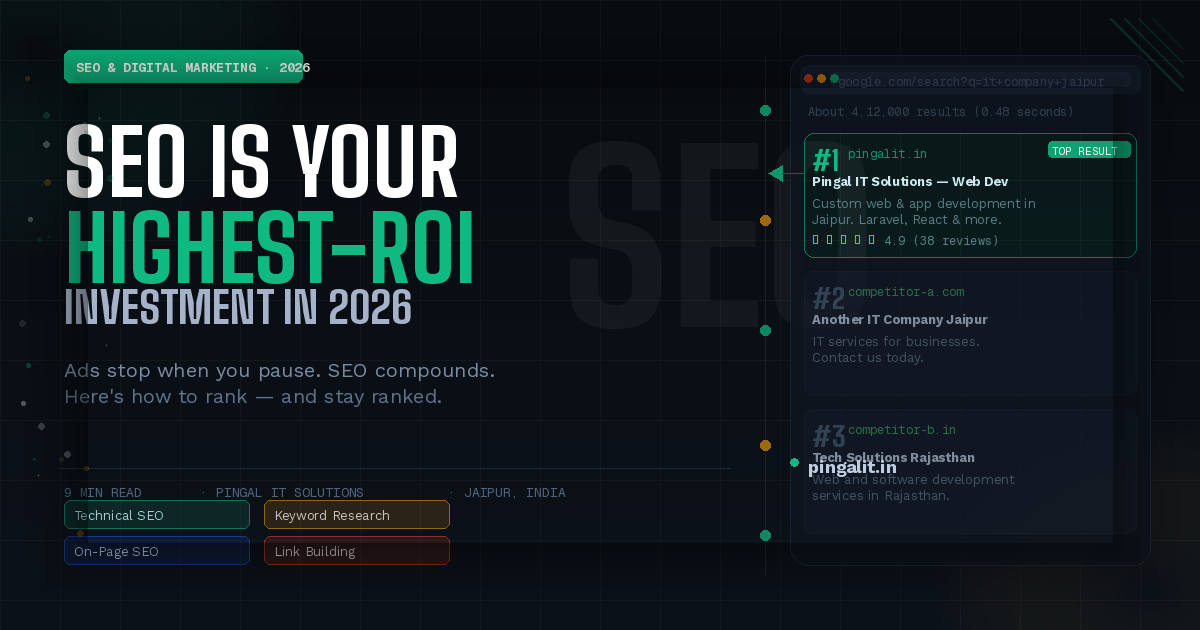
- The first five organic results receive approximately 67% of all clicks
- Less than 1% of users click to page two of Google results
- Organic search drives 53% of all website traffic on average — more than any other channel
- SEO leads have a 14.6% close rate, compared to 1.7% for outbound leads like cold calls
The intent is built in. Someone searching "web development company in Jaipur" is already looking for exactly what you offer. That's not advertising — that's being present at the exact moment of demand.
SEO vs. Paid Ads — Understanding the Difference
Paid advertising (Google Ads, Meta Ads) and SEO both drive traffic, but they work very differently. Neither is wrong — but most businesses don't understand the trade-off clearly enough to allocate their budget wisely.
| Factor | SEO (Organic) | Paid Ads (PPC) |
|---|---|---|
| Cost per click over time | ✅ Decreases as rankings improve | ❌ Stays the same or increases |
| Traffic when you stop | ✅ Continues (rankings hold) | ❌ Stops immediately |
| Time to results | ⏳ 3–6 months to build | ✅ Immediate traffic |
| Long-term ROI | ✅ Compounding returns | ❌ Linear spend = linear results |
| Trust & credibility | ✅ Higher — users trust organic | ❌ Lower — visibly an ad |
| Best for | Long-term sustainable growth | Launches, promos, fast results |
💡 The smart approach: Use paid ads to generate immediate leads while your SEO builds. Once your organic rankings mature, reduce ad spend and let SEO carry the load — at a fraction of the ongoing cost.
The 5 Pillars of a Strong SEO Strategy in 2026
SEO is not a single tactic — it's a system. Businesses that treat it as "just keywords" get average results. Those who treat it as a multi-layered strategy see compounding growth. Here are the five pillars that matter most today:
1. Technical SEO — Your Foundation
Before content or links, your website needs to be technically sound. Google can't rank what it can't crawl and understand. Technical SEO covers:
- Page speed — Google's Core Web Vitals are a direct ranking factor. A slow site is a penalised site.
- Mobile-first indexing — Google primarily uses your mobile version to rank your site. If your mobile experience is poor, your rankings suffer.
- Crawlability — Clean URL structures, proper sitemaps, and no broken links ensure Google can index your entire site.
- HTTPS & security — Non-secure sites are flagged and rank lower.
- Structured data (Schema markup) — Helps Google understand your content and can trigger rich results like star ratings and FAQs in search.
2. Keyword Research — Understanding What Your Customers Actually Search
Effective keyword research is not about finding high-volume terms and stuffing them into pages. It's about understanding search intent — what someone is actually trying to accomplish when they type a query. In 2026, Google is exceptionally good at understanding intent, and rewards content that genuinely matches it.
A smart keyword strategy maps queries to three intent types:
- Informational — "how to choose a web developer" → blog content
- Commercial — "best web development company Jaipur" → service/comparison pages
- Transactional — "hire web developer Jaipur" → direct service pages with a CTA
3. On-Page SEO — Optimising What's Already There
Every page on your website is an opportunity to rank. On-page SEO ensures each page is structured in a way Google understands and users find compelling:
- Clear, keyword-aligned title tags and meta descriptions
- Logical heading hierarchy (H1 → H2 → H3)
- Internal linking — connecting related pages keeps users on your site longer and distributes ranking authority
- Image alt text — helps with accessibility and image search rankings
- Content depth — comprehensive, expert content consistently outranks thin pages
4. Content Marketing — The Engine That Keeps Running
Every high-quality blog post, guide, or resource you publish is a new entry point for organic traffic. Content builds authority over time — a post published today can drive steady traffic for three to five years with minimal additional investment.
The most effective content strategies for SMBs in 2026 focus on:
- Long-form guides that answer questions comprehensively (like this post)
- Local content targeting city or region-specific searches ("web development company in Jaipur")
- Case studies and project showcases — demonstrate real expertise, not just claimed expertise
- FAQ content targeting voice search and Google's "People Also Ask" boxes
5. Link Building — Earning Authority
Backlinks — other websites linking to yours — remain one of Google's strongest ranking signals. A link from a credible, relevant website tells Google your content is trustworthy. Quality matters far more than quantity here. One link from a reputable industry publication is worth more than fifty from low-quality directories.
Ethical, effective link-building strategies include guest posting on relevant blogs, getting listed in industry directories, creating genuinely useful resources others want to reference, and earning mentions in local press and business publications.
Local SEO — The Biggest Untapped Opportunity for Jaipur Businesses
If your business serves customers in a specific city or region, Local SEO is your single most powerful tool — and it's consistently underutilised by SMBs across Rajasthan.
Local SEO helps your business appear in:
- Google Maps results when someone searches nearby
- The "Local Pack" — the three businesses that appear at the top of local search results
- Searches with local intent like "IT company near me" or "web developer Jaipur"
The foundations of Local SEO are:
- Google Business Profile (GBP) — fully completed, regularly updated with posts, photos, and responses to reviews
- Consistent NAP (Name, Address, Phone) across all directories and your website
- Local citations — listings on JustDial, IndiaMart, Sulekha, and relevant local directories
- Customer reviews — Google reviews are a direct Local SEO ranking factor. More 5-star reviews = higher local rankings
- Location pages on your website targeting specific areas you serve
💡 Quick win: If you haven't fully optimised your Google Business Profile, do it today. It's free, takes less than an hour, and can move your business into the local pack for high-intent searches almost immediately.
How Long Does SEO Actually Take? Setting Realistic Expectations
This is the question every business asks — and the honest answer is: it depends, but typically 3–6 months for meaningful traction and 6–12 months for strong ROI. Here's a realistic timeline breakdown:
| Timeframe | What to Expect |
|---|---|
| Month 1–2 | Technical audit, fixes, keyword research, on-page optimisation begins. No visible ranking changes yet — foundations being laid. |
| Month 3–4 | First rankings improvements for lower-competition keywords. Organic traffic begins to tick upward. Content publishing in full swing. |
| Month 5–6 | Meaningful traffic growth. Some target keywords reaching page one. Lead quality from organic noticeably higher than paid. |
| Month 7–12 | Strong ROI visible. Rankings for competitive keywords improving. Organic becomes a reliable, growing lead channel. |
| Year 2+ | Compounding returns. Each piece of content and each link makes the whole strategy stronger. Cost per lead drops significantly. |
The businesses that struggle with SEO are the ones who stop at month three expecting month-twelve results. Consistency is the entire game.
How Pingal IT Solutions Approaches SEO & Digital Marketing
At Pingal IT Solutions, Jaipur, our SEO and digital marketing work is built around one principle: every rupee you spend should be traceable to a business outcome. We don't do vanity metrics — we focus on rankings, traffic, leads, and revenue.
Our SEO service covers the full stack:
- Technical SEO Audit — a complete crawl and analysis of your site identifying every issue hurting your rankings
- Keyword & Competitor Research — understanding exactly what your customers search and where your competitors rank
- On-Page Optimisation — every service page, landing page, and blog post structured to rank and convert
- Content Strategy & Writing — regular, expert blog content that builds authority and captures long-tail traffic
- Local SEO — Google Business Profile management, local citations, and review strategy
- Link Building — ethical, white-hat backlink acquisition from relevant, credible sources
- Monthly Reporting — transparent reporting on rankings, traffic, and leads — no black boxes
Conclusion
Paid advertising will always have its place — for launches, for seasonality, for speed. But if you're looking for the marketing investment that grows in value over time, that doesn't disappear when you pause your spend, and that puts you in front of customers exactly when they're looking for you — SEO is the answer.
The best time to start was a year ago. The second best time is today.
Ready to build a search presence that works for your business 24/7? Get in touch with Pingal IT Solutions — we'll audit your current SEO and show you exactly where the opportunities are.