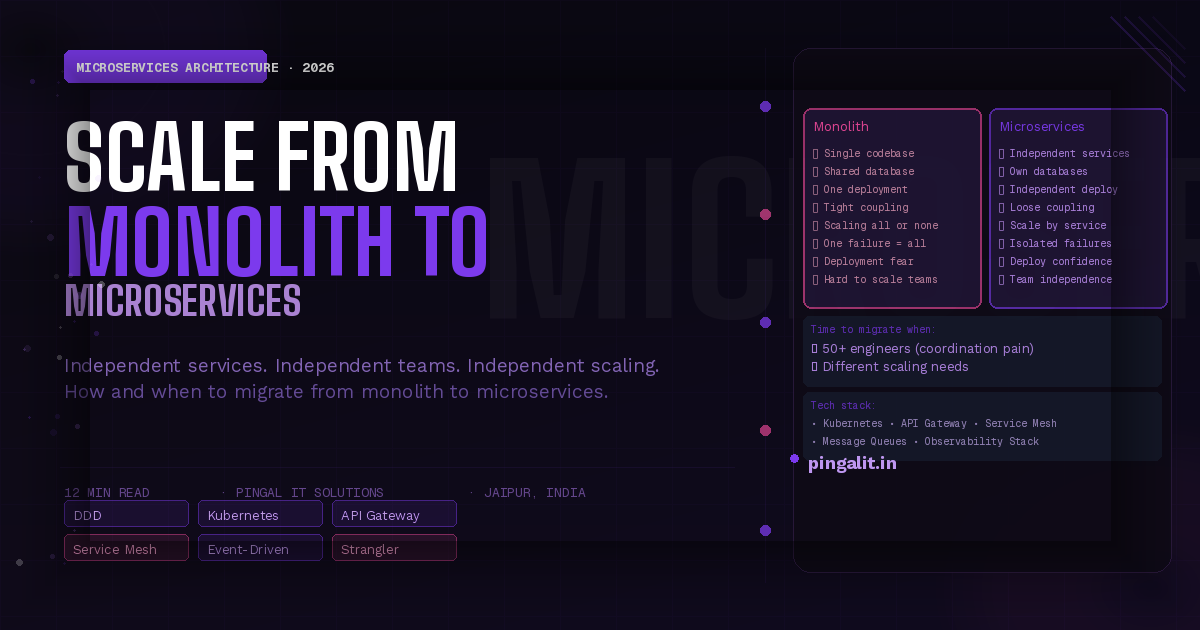
Your application started as a monolith: one codebase, one database, one server. This worked fine when you had one team and one product. Now you have 10 engineers, multiple product lines, and a codebase that's become unmaintainable. Deploying a small feature requires the entire team to coordinate. A bug in one part breaks everything. Scaling one component means scaling the entire application.
This is the breaking point where monoliths stop working. You've reached the scale where microservices become not just an option, but a necessity.
Microservices — breaking your monolith into small, independently deployable services — solve the scaling, reliability, and development velocity problems that plague large systems. But they introduce new challenges: complexity, distributed systems debugging, and operational overhead.
This guide explains what microservices are, when you actually need them, what they solve, what new problems they create, and how to migrate from a monolith without crashing your business.
The Monolith Problem — And When It Becomes Critical
Monolithic architecture — one codebase, one deployment unit, one database — works well for small teams and early-stage products. But as systems grow, the monolith becomes a bottleneck:
Development Bottlenecks
- Slow builds and deployments — even small changes require building and deploying the entire application
- Merge conflicts — multiple teams working on the same codebase causes constant conflicts
- Coordination overhead — feature releases require coordination across teams
- Technology lock-in — everyone is forced to use the same tech stack
Operational Problems
- Resource scaling — to scale one slow component, you must scale the entire application
- Reliability — a bug in one component brings down the entire system
- Debugging difficulty — problems are hard to isolate; the entire system is one black box
- Deployment fear — deployments are high-risk events affecting the entire system
Business Impact
- Feature velocity decreases — coordination overhead slows down shipping
- Reliability suffers — outages affect all customers and all products
- Scaling costs spike — you pay for capacity you don't need
- Team growth becomes painful — adding engineers slows things down instead of speeding them up
At some point — typically around 50-100 engineers or ₹10+ crore in annual revenue — the monolith becomes your constraint. That's when microservices become necessary.
What Are Microservices — And Why They Solve Monolith Problems
Microservices architecture breaks your monolith into small, focused services, each with its own codebase, database, and deployment cycle. Instead of one big application, you have dozens of small applications that communicate via APIs.
Core Principles of Microservices
- Single responsibility — each service does one thing well (user management, payments, inventory, etc.)
- Independent deployment — you can deploy one service without deploying others
- Decentralized data — each service owns its own database; no shared monolithic database
- Technology diversity — different services can use different tech stacks
- Loose coupling — services communicate via APIs, not shared code
How Microservices Solve Monolith Problems
Development Bottleneck: Small teams own small services. They can deploy independently without coordinating with others.
Scaling: If your payment service is slow, you scale only the payment service, not the entire system.
Reliability: If the payment service crashes, your core application keeps running. Failures are isolated.
Technology freedom: Your user service can use Node.js, your payment service can use Python, your search service can use Go. Each team uses the best tool for their problem.
Feature velocity: Teams move independently. Your user service team can deploy multiple times per day without waiting for the payments team.
The Microservices Tradeoff — Complexity Is Real
Microservices solve monolith problems but introduce new ones. This is critical to understand: microservices are only worth adopting if the problems they solve are worse than the problems they create.
New Problems Microservices Create
- Distributed systems complexity — debugging across 20 services is exponentially harder than debugging one application
- Network latency — services communicate over the network, which is slower than in-process function calls
- Data consistency — with distributed databases, maintaining data integrity becomes complex
- Operational overhead — you need sophisticated orchestration, monitoring, and logging
- Organizational complexity — microservices require Conway's Law: your architecture mirrors your org structure
- Testing difficulty — integration tests spanning multiple services are complex and slow
When Microservices Are Worth It
Only adopt microservices when:
- Your monolith has become a development bottleneck
- You have 50+ engineers who would benefit from independent teams
- Different parts of your system have vastly different scaling needs
- You have the operational expertise to run distributed systems
- You're willing to invest in orchestration, monitoring, and tooling
Premature microservices are a mistake. Build a monolith first. Once you've proven the business model and hit scaling walls, then migrate.
Microservices Architecture Patterns — How to Structure Services
Domain-Driven Design (DDD)
Organize services around business domains, not technical layers. Instead of a "database service" and an "API service," you have a "user service," "payments service," "inventory service." Each service is responsible for one business domain.
API Gateway Pattern
A single entry point that routes requests to appropriate services, handles authentication, rate limiting, and caching. Clients don't call services directly; they call the API gateway.
Service Discovery
Services need to find each other in a distributed environment. Service discovery (using tools like Consul or Kubernetes) automatically registers services and routes traffic accordingly.
Event-Driven Communication
Services communicate asynchronously via events rather than direct API calls. When an order is paid, the payment service emits an "OrderPaid" event that the inventory service listens to and acts on. This decouples services and improves resilience.
Circuit Breakers
If a service is failing, a circuit breaker stops sending requests to it and returns a cached response or error. This prevents cascading failures where one slow service brings down others.
The Migration Path — From Monolith to Microservices
Phase 1: Strangler Pattern (Months 1-3)
Don't rewrite everything. Extract services one at a time from your monolith using the strangler pattern: route traffic for one domain to a new service while the monolith handles the rest. Gradually strangle the monolith.
Phase 2: Service Extraction (Months 3-12)
Extract your most independent services first (user management, logging, search). Leave tightly coupled services in the monolith until you understand the boundaries.
Phase 3: Orchestration (Months 6+)
Implement Kubernetes or similar orchestration to manage service deployment, scaling, and health.
Phase 4: Observability (Months 6+)
Implement distributed tracing, metrics collection, and logging. In microservices, observability is critical.
Phase 5: Mature Microservices (Year 1+)
Once you have 10+ services running stably, you've achieved mature microservices architecture.
Technology Stack for Microservices
| Layer | Tools | Purpose |
|---|---|---|
| API Gateway | Kong, AWS API Gateway, Nginx | Single entry point for all client requests |
| Service Mesh | Istio, Linkerd | Service-to-service communication, traffic management, security |
| Orchestration | Kubernetes, Docker Swarm | Deploy, scale, and manage containerised services |
| Message Queue | RabbitMQ, Apache Kafka, AWS SQS | Asynchronous communication between services |
| Service Discovery | Consul, Eureka, Kubernetes DNS | Services find and communicate with each other |
| Monitoring & Logging | Prometheus, ELK Stack, DataDog | Observe service health and debug issues |
| Distributed Tracing | Jaeger, Zipkin | Track requests across multiple services |
You don't need all of these immediately. Start with container orchestration (Kubernetes) and monitoring. Add service mesh and distributed tracing as complexity grows.
Microservices Pitfalls — What Goes Wrong and How to Avoid It
Pitfall 1: Too Many Services Too Fast
Creating a microservice for every feature multiplies operational complexity. Start with 3-5 core services and grow slowly.
Pitfall 2: Poor Service Boundaries
If services are poorly bounded, you'll have constant inter-service communication and tight coupling. Use domain-driven design to think through boundaries before extracting.
Pitfall 3: Insufficient Monitoring
In a monolith, a single error log tells you what broke. In microservices, an issue is scattered across 20 services. Without distributed tracing and monitoring, debugging is impossible.
Pitfall 4: Database Per Service Misunderstood
"Each service has its own database" doesn't mean one database per service. It means services don't share schemas. They can share the same physical database but own separate tables.
Pitfall 5: Microservices Without DevOps Maturity
Microservices require sophisticated deployment, monitoring, and alerting. Don't migrate to microservices if you don't have solid CI/CD and DevOps practices.
Is Your Monolith Ready to Migrate?
Ask yourself:
- Do you have 50+ engineers struggling to coordinate?
- Are deployments slow and risky?
- Do different parts of your system have very different scaling needs?
- Do you have operational expertise (Kubernetes, distributed systems)?
- Is your business model proven? (Don't microservice a failing product)
If you answered yes to most of these, you're ready. If not, stay with the monolith and optimise it.
How Pingal IT Solutions Approaches Microservices
At Pingal IT Solutions, we've architected and migrated multiple large systems to microservices. Our approach:
- Honest assessment first — is your monolith actually the problem? Are you ready for microservices complexity?
- Strangler pattern migration — we extract services one at a time, minimising risk
- Domain-driven design — we use DDD to define service boundaries correctly
- Kubernetes-based orchestration — containerised services on Kubernetes for scalability and reliability
- Observability from day one — distributed tracing, monitoring, and alerting are built in
- Event-driven architecture — asynchronous communication between services for loose coupling
Our microservices services include:
- Architecture assessment and design
- Monolith to microservices migration
- Service boundary definition using DDD
- Kubernetes and container orchestration
- Service mesh implementation (Istio, Linkerd)
- Distributed tracing and observability setup
- Team structure and Conway's Law alignment
Conclusion
Microservices are not a universal solution. They're a tool for solving specific problems that only large, growing systems face. Use them when the monolith becomes your constraint. Don't use them prematurely.
When you do migrate, do it carefully. The strangler pattern, solid service boundaries, and operational maturity are what separate successful migrations from failed ones.
Is your monolith showing signs of strain? Talk to Pingal IT Solutions — we'll assess whether microservices are right for you and design a migration strategy that works.