Every modern web application built in the last five years was likely built with or powered by React. Facebook created it. Netflix uses it. Uber, Airbnb, Dropbox, Shopify — all built their interfaces with React. In 2026, it remains the dominant frontend framework for building sophisticated, interactive web applications.
But React is not just for giant tech companies anymore. Businesses of every size — from Indian SMBs to startups — are building custom applications with React because it delivers three things reliably: speed, scalability, and developer productivity.
This guide covers what React is, why it matters, when to use it, and what to expect when building a React application for your business.
What Is React — And Why Did It Change Web Development?
React is a JavaScript library for building user interfaces using components. Instead of thinking about web pages as monolithic HTML documents that reload, React lets you think in terms of self-contained, reusable components — buttons, forms, cards, navigation menus — each with their own state and logic.
When data changes, React automatically updates only the parts of the page that need to change, without a full page reload. This produces interfaces that feel fast, responsive, and native-like — even though they're running in a browser.
This approach was revolutionary when React was released in 2013, and it has remained the standard for frontend development ever since.
React in 2026 — The Current Landscape
React has matured significantly since its early days. The ecosystem has matured too. In 2026, building a production React application means choosing from a richer set of tools than ever before:
React 19 — Faster, Simpler, More Powerful
The latest version of React (19.x) introduced Server Components, which allow rendering components on the server and sending pre-rendered HTML to the browser — combining the performance benefits of server-side rendering with the interactivity of React. For most business applications, Server Components represent a significant performance improvement over older approaches.
Next.js — The React Meta-Framework
Next.js has become the de facto standard way to build production React applications. It provides file-based routing, server-side rendering, static site generation, API routes, and deployment tooling all built-in. If you're building a React application in 2026, you're likely building it with Next.js.
TypeScript — Industry Standard
Most professional React codebases written in 2026 use TypeScript, which adds static type checking to JavaScript. This catches bugs at development time rather than runtime and makes large React applications significantly more maintainable.
Component Libraries and Design Systems
Rather than building UI components from scratch, most teams now use component libraries like Shadcn, Material-UI, or Chakra UI. These provide pre-built, accessible, professionally designed components that dramatically accelerate development.
When to Choose React — And When Not To
React is powerful, but it is not the right choice for every project. Understanding where it excels helps you make the right architectural decision:
| Project Type | React a Good Fit? | Why |
|---|---|---|
| Business dashboard / admin panel | ✅ Excellent | Complex state, real-time updates, rich interactions |
| SaaS product | ✅ Excellent | Sophisticated UI, user-specific data, frequent updates |
| Single Page Application (SPA) | ✅ Excellent | Fast navigation without page reloads |
| E-commerce storefront | ✅ Good | Works well, but SEO requires server-side rendering (Next.js) |
| Mobile app (with React Native) | ✅ Good | Share code between web and mobile |
| Content-heavy marketing site | ⚠️ Maybe | Overkill for static content; WordPress or Next.js static generation might be better |
| Real-time collaborative app | ✅ Good | Works well; combine with WebSocket libraries like Socket.io |
| Simple brochure website | ❌ Not recommended | Adds unnecessary complexity; use WordPress or static HTML |
The React Development Stack in 2026
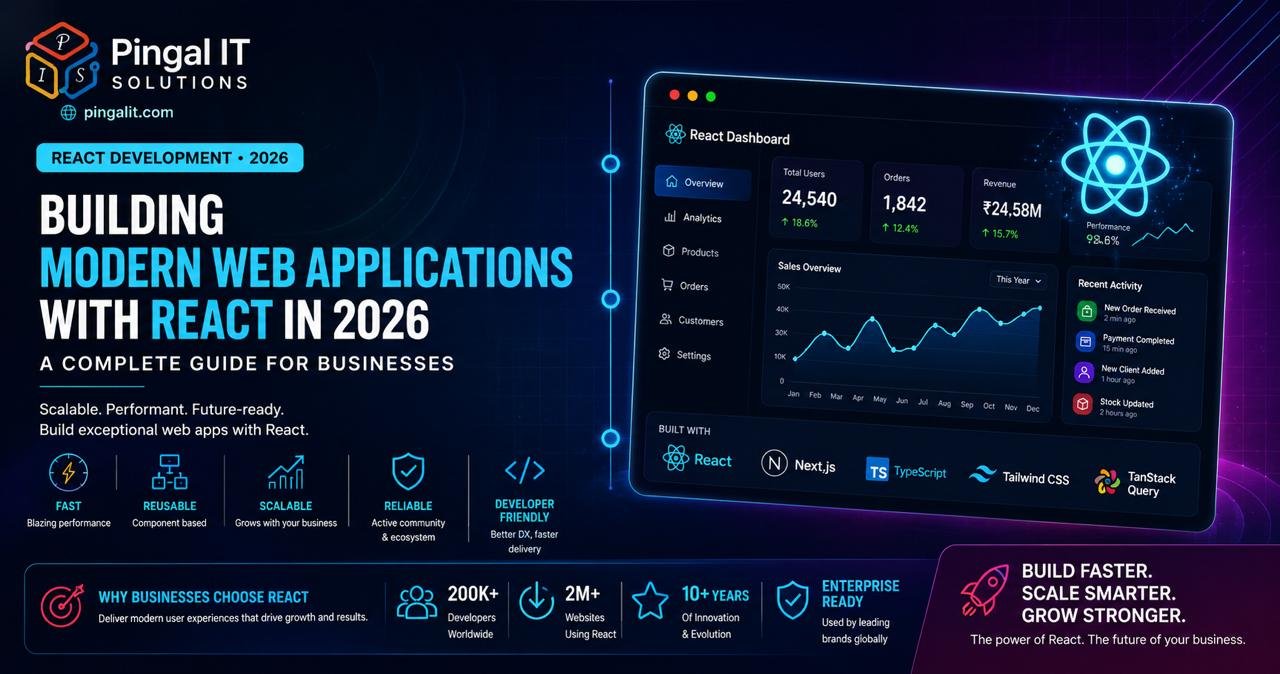
A modern React application for business purposes typically combines these technologies:
- React 19 — the UI library itself
- Next.js 15+ — meta-framework providing routing, server rendering, and deployment
- TypeScript — static type checking for JavaScript
- Tailwind CSS — utility-first CSS for styling without context-switching
- Shadcn/UI or similar — pre-built, accessible component library
- TanStack Query (React Query) — efficient server state management
- Zustand or Recoil — lightweight client state management when needed
- Jest + React Testing Library — testing framework and utilities
- Vercel or similar platform — deployment and hosting
This stack is battle-tested across thousands of production applications and represents the current industry standard.
Building a React Application — What the Process Looks Like
A professional React development engagement typically follows this structure:
1. Discovery and Requirements
Understanding the business problem, the users, and their needs. What is the application trying to accomplish? Who are the users and what are their workflows? What data flows through the system?
2. Design and Prototyping
Creating wireframes and interactive prototypes to validate the user experience before writing production code. A good prototype catches UX issues that would be expensive to fix in code.
3. Architecture Design
Defining the data structures, API contracts, component hierarchy, and state management approach. Good architecture decisions here shape the entire project.
4. Component Development
Building React components in isolation, with stories in Storybook for design review and testing. Component-driven development produces reusable, testable code.
5. API Integration
Connecting the React frontend to backend APIs. Modern React applications typically use REST or GraphQL APIs for server communication.
6. Testing
Unit tests for individual components and functions, integration tests for user workflows, and end-to-end tests for critical paths. Properly tested React applications are safe to refactor and extend.
7. Performance Optimization
Code splitting, lazy loading, caching, and bundling optimization to ensure the application loads fast and feels responsive.
8. Deployment and Monitoring
Setting up automated deployments, monitoring application health, and establishing alerting for production issues.
React Performance — Addressing Common Concerns
A misconception about React is that it is slower than other approaches. In reality, React applications are frequently faster than traditional server-rendered applications, because they can update only the parts of the page that changed, without a full page reload.
Performance optimization in React is straightforward once you understand the principles:
- Code splitting — lazy load components and code that isn't needed immediately
- Memoization — prevent unnecessary re-renders of components that haven't changed
- Server-side rendering (Next.js) — render initial HTML on the server for faster first paint
- Efficient data fetching — use React Query to cache server data and avoid redundant requests
- Image optimization — automatically compress and serve responsive images
A well-built React application with proper optimization consistently scores above 90 on Google PageSpeed Insights.
React Developers in India — Availability and Quality
India has a large, vibrant community of React developers. The skill is in high demand and relatively abundant compared to other specialisations. This means hiring React developers is straightforward, and rates are competitive compared to other tech hubs globally.
For businesses choosing a development partner, React's popularity in India means you have genuine optionality in choosing a team with proven expertise and a strong portfolio of production applications.
How Pingal IT Solutions Builds React Applications
At Pingal IT Solutions, Jaipur, React development is one of our core specialisations. We have built React applications for logistics companies, healthcare platforms, retail systems, and SaaS products — ranging from simple dashboards to complex, real-time collaborative applications.
Our approach to React development is simple: architecture-first, test-driven, and focused on building applications that are fast, maintainable, and a genuine asset to your business.
We use the modern React stack — Next.js, TypeScript, Tailwind, TanStack Query — not because it's trendy, but because it produces the best results for production applications.
Our React services include:
- React + Next.js full-stack application development
- React dashboard and admin panel development
- SaaS product frontend development
- React application performance optimization
- React component library and design system development
- Legacy React application modernisation
- React to Next.js migration
Conclusion
React in 2026 is mature, proven, and the industry standard for building sophisticated web applications. It is not hype — it is the practical choice for any business building interactive, data-driven web applications.
Choosing React means choosing an ecosystem with exceptional tooling, a massive community, abundant resources, and a talent pool that is easy to access. For businesses building custom web applications, those advantages compound significantly over time.
If you have a business problem that requires a custom web application, React is almost certainly the right foundation. Talk to Pingal IT Solutions — we'll assess your requirements and show you what's possible with modern React development.