When businesses need a custom web application built — a client portal, an internal management system, an API-driven platform, or a complex e-commerce backend — the technology choice made at the start shapes everything that follows. Performance, security, development speed, maintenance cost, and scalability all hinge on picking the right foundation.
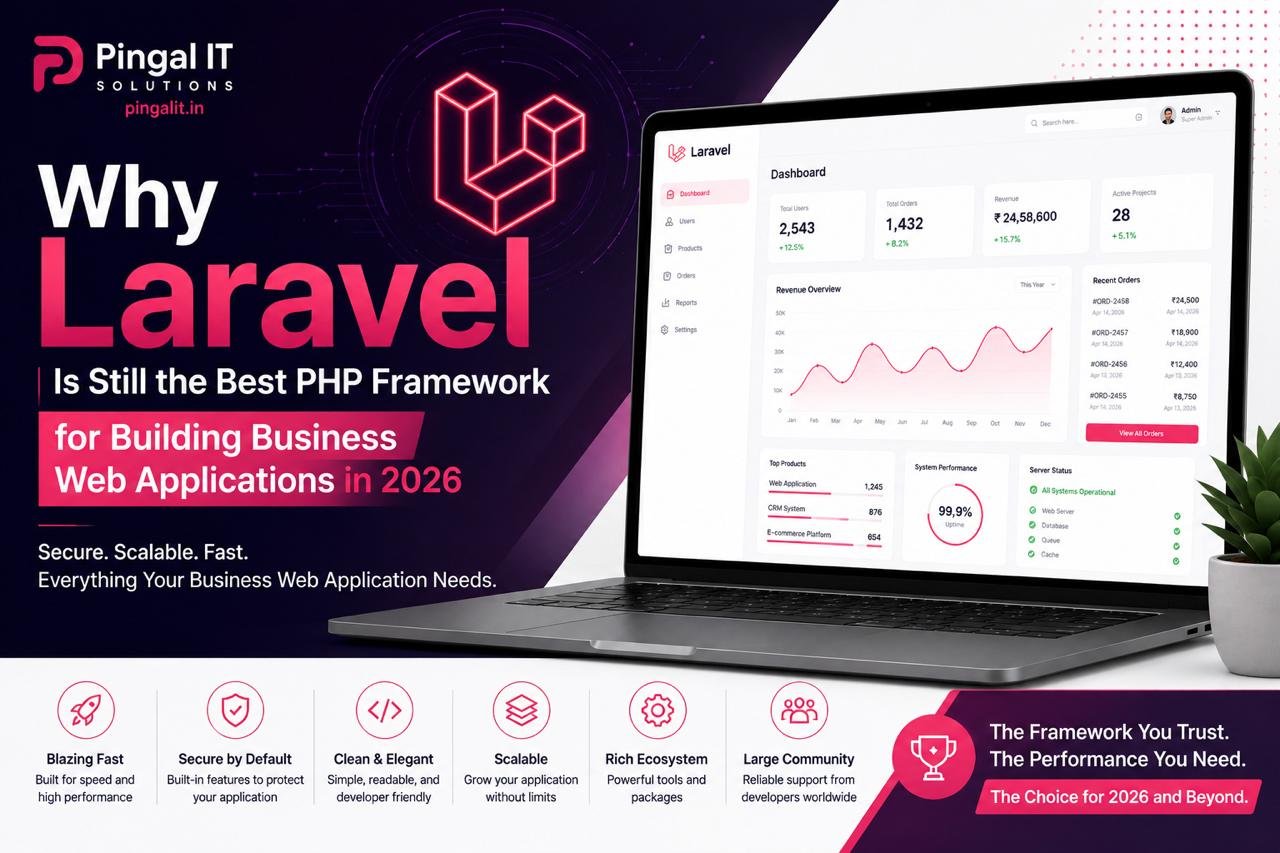
In the PHP ecosystem, that foundation is overwhelmingly Laravel. Since its release in 2011, Laravel has grown to become the most popular PHP framework in the world — and in 2026, it remains the most productive, most elegant, and most business-appropriate choice for building serious web applications.
This guide explains what Laravel is, why it dominates custom web application development, what it's genuinely best suited for, and what to look for in a Laravel development partner.
What Is Laravel — And Why Does It Matter?
Laravel is an open-source PHP web application framework built around the Model-View-Controller (MVC) architectural pattern. It provides a structured, expressive syntax and a comprehensive ecosystem of tools that dramatically accelerates development while enforcing best practices in security, code organisation, and maintainability.
To understand why this matters, consider the alternative. Building a web application without a framework means writing boilerplate code for authentication, database interaction, routing, form validation, session management, and security from scratch — every time, for every project. A framework like Laravel provides all of this out of the box, freeing developers to focus on the specific business logic that makes your application unique.
The result: faster development, lower cost, more consistent quality, and applications that are significantly easier to maintain and extend over time.
What Makes Laravel the Developer's and Business Owner's Choice in 2026
Eloquent ORM — Database Work That Is Actually Readable
Laravel's Eloquent ORM (Object-Relational Mapping) lets developers interact with databases using clean, expressive PHP code rather than raw SQL queries. Relationships between data models are defined once and then used intuitively throughout the application. This produces code that is readable, maintainable, and far less prone to the SQL injection vulnerabilities that plague applications built with raw database queries.
Blade Templating Engine
Laravel's Blade templating system makes building dynamic web interfaces clean and straightforward. Template inheritance, reusable components, and conditional rendering are all handled elegantly, producing consistent front-end output without mixing business logic into presentation code.
Built-In Authentication and Authorisation
User authentication — registration, login, password reset, email verification — is among the most security-critical code in any web application, and also among the most repetitive to implement. Laravel provides complete, battle-tested authentication scaffolding out of the box, with packages like Laravel Breeze and Jetstream offering modern starter kits for different UI preferences. Role-based access control and fine-grained permissions are handled by Laravel's built-in Gate and Policy system.
Artisan CLI — Automation Built In
Laravel's Artisan command-line interface automates repetitive development tasks — generating boilerplate code, running database migrations, seeding test data, clearing caches, and running scheduled tasks. Teams working on Laravel projects ship faster because the framework eliminates the manual scaffolding work that consumes time on every project.
Queue System for Background Jobs
Real business applications routinely need to perform tasks that shouldn't block the user's experience — sending emails, processing file uploads, generating reports, calling third-party APIs. Laravel's Queue system makes this straightforward, supporting multiple queue backends (Redis, Amazon SQS, database) with a unified API. Background jobs are a standard part of every non-trivial Laravel application.
Comprehensive Testing Support
Laravel is built with testing in mind. PHPUnit is included by default, and Laravel adds a rich set of testing helpers that make writing feature tests — simulating HTTP requests, testing database interactions, asserting application behaviour — dramatically faster than raw PHPUnit. Applications built with Laravel tests are more reliable and far safer to refactor and extend.
Laravel Ecosystem — Tools for Every Requirement
Beyond the core framework, the Laravel ecosystem includes first-party packages that address common enterprise requirements without requiring third-party solutions:
- Laravel Sanctum / Passport — API authentication for SPAs and mobile apps
- Laravel Horizon — beautiful dashboard for monitoring queue jobs
- Laravel Telescope — development debugging and profiling tool
- Laravel Cashier — subscription billing integration with Stripe and Paddle
- Laravel Scout — full-text search integration with Algolia, Meilisearch, and Elasticsearch
- Laravel Socialite — OAuth authentication with Google, Facebook, GitHub, and more
- Laravel Nova — beautiful administration panel for managing application data
Laravel vs. Other Frameworks — An Honest Comparison
| Factor | Laravel (PHP) | Django (Python) | Node.js / Express | Ruby on Rails |
|---|---|---|---|---|
| Developer availability in India | ✅ Very high | ✅ High | ✅ High | ⚠️ Moderate |
| Development speed | ✅ Very fast | ✅ Fast | ⚠️ Moderate (more setup) | ✅ Fast |
| Built-in features | ✅ Comprehensive | ✅ Comprehensive | ❌ Minimal (build your own) | ✅ Comprehensive |
| Hosting cost in India | ✅ Low — PHP hosting widespread | ⚠️ Moderate | ⚠️ Moderate | ⚠️ Moderate to high |
| Performance at scale | ✅ Excellent with caching | ✅ Excellent | ✅ Excellent (async) | ⚠️ Can struggle |
| Ecosystem maturity | ✅ Mature, stable | ✅ Mature | ⚠️ Fragmented | ✅ Mature |
| Best for | Business apps, APIs, CMS, e-commerce | Data-heavy apps, ML integration | Real-time apps, microservices | Rapid prototyping |
For businesses building custom web applications — portals, management systems, APIs, e-commerce platforms — Laravel's combination of development speed, developer availability, hosting cost, and ecosystem depth makes it the pragmatic choice in the vast majority of cases.
What Laravel Is Built For — and What It Isn't
Laravel excels at a specific class of applications. Understanding its sweet spot helps you make the right technology decision:
Where Laravel Shines
- Business web applications — CRM systems, ERP modules, inventory management, booking platforms, client portals
- REST APIs and GraphQL backends — powering mobile apps, React/Vue frontends, and third-party integrations
- E-commerce platforms — custom storefronts, multi-vendor marketplaces, B2B ordering systems
- Content management systems — custom CMS built around specific editorial workflows
- SaaS products — multi-tenant applications with subscription billing, user management, and role-based access
- Admin panels and dashboards — internal tools with complex data relationships and reporting requirements
Where Other Technologies May Be More Appropriate
- Real-time applications (live chat, collaborative editing, multiplayer) — Node.js with WebSockets is often more natural, though Laravel Echo + Pusher handles many real-time requirements adequately
- Machine learning pipelines — Python (Django/FastAPI) integrates more naturally with ML libraries
- Ultra-high-performance microservices — Go or Rust may be more appropriate for services with extreme performance requirements
- Simple brochure websites — WordPress is faster and cheaper to build and maintain for content-only sites
The Laravel Development Process — What Good Looks Like
A professional Laravel development engagement follows a structured process that produces applications which are not just functional at launch, but maintainable and extensible for years:
- Requirements and architecture design — defining the data models, relationships, API contracts, and system architecture before writing application code. Architectural decisions made early are far cheaper to change than those discovered post-launch.
- Database schema design — a well-designed database schema is the foundation of a reliable application. Laravel migrations make schema management version-controlled and collaborative.
- API-first development — building the backend API before the frontend enables parallel development and produces a backend that can serve web, mobile, and third-party consumers from the same codebase.
- Feature development in iterations — building and testing features in logical chunks, with code review and automated tests at each stage.
- Security hardening — CSRF protection, SQL injection prevention, XSS mitigation, proper authentication, rate limiting, and input validation are all framework-level concerns in Laravel, but require deliberate configuration.
- Performance optimisation — query optimisation, eager loading to prevent N+1 query problems, Redis caching, and queue offloading for heavy operations.
- Deployment and DevOps — Laravel Forge or Envoyer for zero-downtime deployments, environment configuration management, and monitoring setup.
Laravel Performance — Addressing the "PHP Is Slow" Myth
A persistent misconception about PHP — and by extension Laravel — is that it is inherently slow compared to Node.js or Go. In the context of typical business web applications, this is not a meaningful concern.
Modern PHP (8.x) with OPcache enabled is significantly faster than PHP 5 or 7. Laravel applications with proper caching — Redis for sessions and query caching, a CDN for static assets, optimised Eloquent queries — comfortably handle thousands of concurrent users on modest server infrastructure.
For context: Facebook was built on PHP. Wikipedia runs PHP. Slack's backend includes PHP. The performance characteristics of PHP are more than adequate for the vast majority of business web applications, and Laravel's caching and queue architecture means that performance bottlenecks can be addressed systematically when they occur.
How Pingal IT Solutions Builds Laravel Applications
At Pingal IT Solutions, Jaipur, Laravel is our primary framework for custom web application development. We have built Laravel applications across industries — logistics, healthcare, retail, education, and professional services — ranging from internal business tools to consumer-facing SaaS products.
Our Laravel development practice is built around three principles:
- Architecture first. We design the database schema, API contracts, and system architecture before writing application code. Shortcuts at the architecture stage create technical debt that compounds with every feature added.
- Tested code only. Every feature we build has automated tests. This means your application can be updated, extended, and refactored with confidence — not anxiety.
- You own everything. Full source code, database, documentation, and deployment configuration are handed over at project completion. No lock-in, no dependency on us to keep your application running.
Our Laravel services include:
- Custom web application development from scratch
- REST API and GraphQL API development
- Laravel + React / Vue / Next.js full-stack applications
- Legacy PHP application migration to Laravel
- Laravel application performance audits and optimisation
- SaaS product development with multi-tenancy and subscription billing
- Ongoing Laravel application maintenance and feature development
Conclusion
Laravel's dominance in business web application development is not a marketing position — it is a product of consistently solving real development problems better than the alternatives. In 2026, with PHP 8.3 delivering significant performance improvements and the Laravel ecosystem continuing to evolve, it remains the most productive, most maintainable, and most cost-effective foundation for custom web applications in the Indian market.
If you have a business problem that requires a custom software solution — a process that's outgrown spreadsheets, a client-facing portal, an API backend for your mobile app, or a SaaS idea you want to turn into a product — Laravel is very likely the right foundation to build it on.
Ready to build something with Laravel? Talk to the team at Pingal IT Solutions — we'll scope your requirements and show you exactly what's possible.